About

OPTIMUS-6G is a European research project that aims to develop a multi-domain network architectural framework enhancing multi-functional communication for IoT devices and applications in 6G unlicensed bands. The project will combine multi-band and multi-RAT radio and optical communication technologies, AI-driven cross-layer orchestration, and a digital-twin-enabled framework to optimise heterogeneous IoT operations across the computing continuum and validate them through tangible use cases.


Challenges

Enhance communication technologies and architectures in unlicensed spectrum in 6G.

Fast deployment, operation and spectrum efficiency of IoT in 6G unlicensed bands.

Optimize data processing for resource efficiency and orchestration across the computing continuum.

Evaluation and testing of 6G technologies for multi-Band, AI-Driven, and unlicensed IoT operations.

Objectives

01

Multi-band 6G-IoT Architecture

Design an IoT network architecture based on multi-band and multi-RAT 6G communication technologies for fast, reliable, low-latency unlicensed operations.

02

AI-driven Cross-layer Orchestration

Implement AI-driven multi-RAT orchestration to optimize communications, energy efficiency, resource allocation, and data processing across the computing continuum.

03

Network Digital Twin Framework

Develop a 6G-enabled, IoT-oriented network digital twin framework for planning, simulation, and optimization of the proposed architecture and protocols.

04

Multi-domain Use Case Validation

Evaluate the OPTIMUS-6G framework across multiple domains and service requirements, including industrial, healthcare, and campus network environments.

05

Impact, Exploitation and Standardization

Provide a business value chain of impact and accelerate adoption through dissemination, exploitation, and standardization activities.

Project Approach

OPTIMUS-6G follows an integrated approach that combines multi-band radio and optical communication technologies, hardware-agnostic cross-layer protocols, AI-enabled orchestration and digital-twin-based validation. This approach links the project objectives with the practical evaluation of the OPTIMUS-6G architecture across manufacturing, healthcare and campus network use cases.


Use Cases

Process Automation and Robotic Operations in Smart Factories

This use case will explore the integration of radio technologies in the midband unlicensed bands (sub-10 GHz) to enable ultra-reliable, low latency and resilient wireless connectivity in Industry 5.0 smart factories.
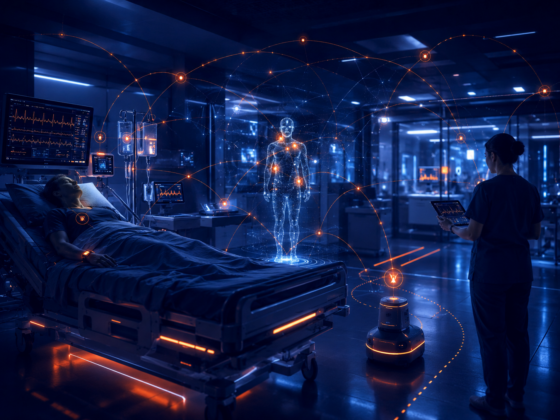
Human Monitoring for Precision Healthcare and Safe Navigation

This use case will validate the performance of the 6G in the unlicensed mmWave bands in IoT wearable devices to enable a secure, low-latency, massive and interference-free communications for healthcare monitoring and human positioning and sensing.

Immersive Virtual Reality in Campus Networks

This use case will evaluate ultra-high-speed, and reliable connectivity throughout the integration of 6G unlicensed operations in the optical bands for IoT immersive applications in a campus network.

0
0
0

Impact

Target Groups

OPTIMUS-6G targets a broad stakeholder ecosystem, including operators, infrastructure and telecom providers, manufacturers, ICT providers and integrators, vertical industries, deep-tech SMEs and spin-offs, academia and the research community, standardization and policy-making bodies, as well as citizens and society.

Expected Outcomes

  • Enable low-energy IoT devices through low-power transceivers, energy-aware protocols, AI-driven orchestration and edge computing.
  • Support reliable and efficient IoT operations in unlicensed 6G bands through multi-band architectures, RF/VLC integration and AI-based orchestration.
  • Deliver innovative multi-band IoT devices with ISAC, spectrum-aware operation, AI-driven orchestration and Digital Twin-assisted optimisation.

Long-Term Impacts

Economic

Support European growth through cost-efficient unlicensed 6G, lower deployment costs and innovation across key verticals.

Societal

Enable trusted services for healthcare, human-robot collaboration and immersive learning, with attention to privacy and resilience.

Research & Technological

Advance 6G through digital twins, cross-layer protocols, AI-native orchestration, IoT architectures and open testbeds.

Environmental

Support energy-efficient connectivity through low-power RF/VLC, AI-optimised offloading, energy harvesting and digital-twin-based optimisation.

Back to top